


Article Overview: AI for customer support works best when automation and human expertise have clear roles. This article explores practical ways to decide what tasks AI should handle and what agents should own.
The Best AI Is the Kind Customers Hardly Notice
Customers have become surprisingly accepting of AI in customer support. Most expect they may interact with a chatbot before reaching a person. What they have very little patience for is having to start over after they’ve already explained the problem.
Customers experience AI and human support as one conversation. Every decision a support team makes either moves the issue forward or forces customers to retrace their steps. That means deciding whether AI should answer product questions, provide order updates, or help customers access their accounts, and knowing when conversations like billing disputes or complex technical issues should go directly to an experienced agent. When an agent steps in, the conversation should continue where AI left off. Customers shouldn’t have to repeat themselves.
Salesforce’s 2025 State of Service report found that AI is expected to handle 50% of service cases by 2027, up from 30% in 2025. That makes the handoff between automation and agents more than a workflow detail. It’s quickly becoming part of the core customer experience.
As AI becomes a larger part of support operations, the technology itself is becoming less of a differentiator. The real advantage comes from deciding where AI adds speed, where people add judgment, and making sure customers move seamlessly between the two. Organizations that get those decisions right build support operations that are easier to scale without making the customer experience feel impersonal.
Decide What Good Automation Looks Like
Before deciding where to automate customer support, define the problem you’re trying to solve. The strongest AI implementations begin with a clear understanding of where automation can improve the customer experience and where people continue to make the biggest difference.
Start by reviewing your top contact reasons from the last three to six months. Don’t stop at ticket volume. Look for requests that reach the same resolution almost every time and separate them from the ones that require investigation or judgment.
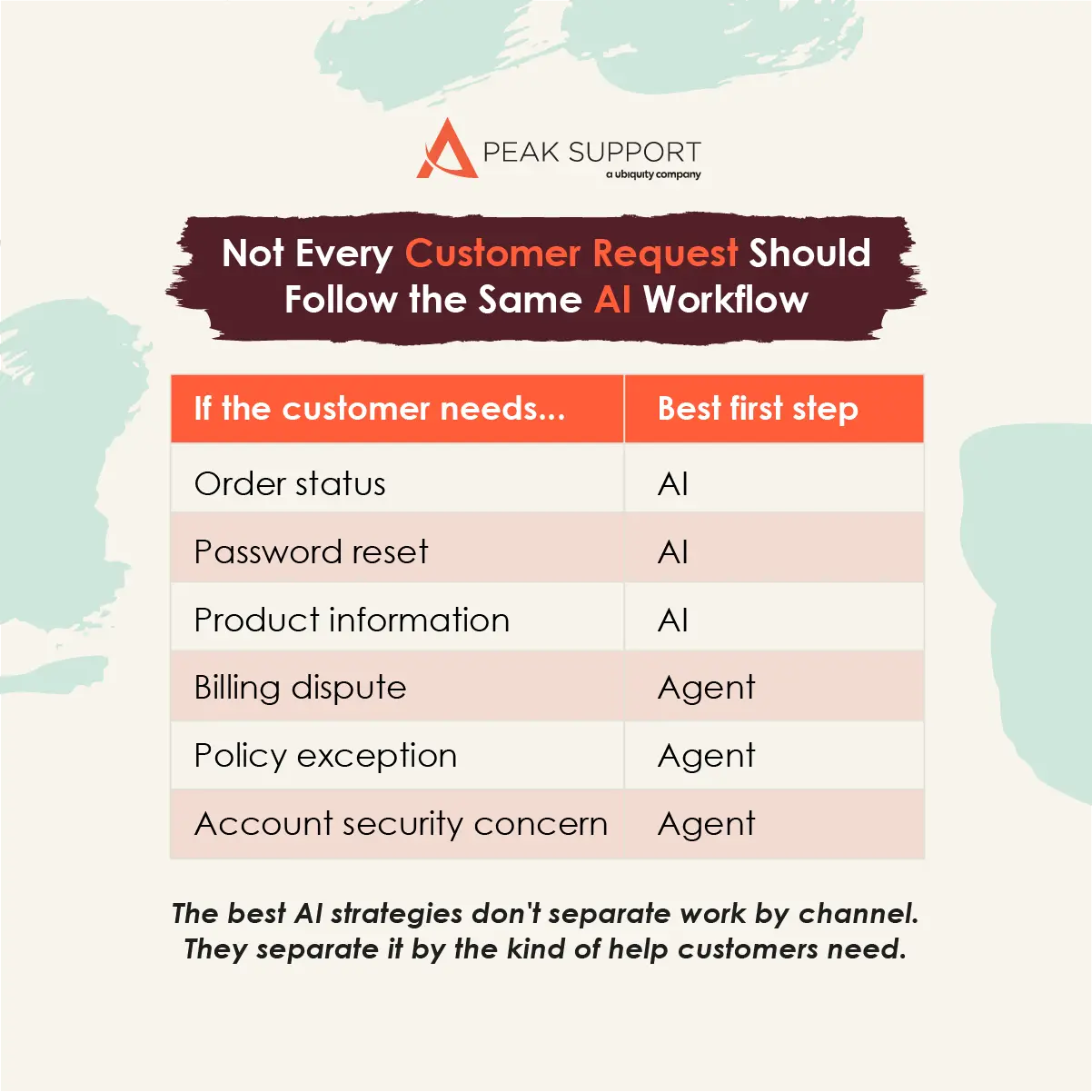
Good candidates for automation: Requests with a consistent resolution, such as order updates, account access, subscription changes, or basic product questions. Customers get faster answers, and agents stay available for conversations that benefit from human expertise.
- Better handled by agents: Billing disputes, complex technical troubleshooting, account security concerns, and policy exceptions. These conversations depend on context, careful questioning, and informed decisions that AI can’t reliably make on its own.
One more pattern is worth paying attention to. If customers frequently ask for an agent after interacting with AI, don’t assume the chatbot is the problem. Review where the conversation is being transferred, what information the agent receives, and whether the request should have reached a person sooner. Small decisions like these have a much bigger impact on customer effort than simply expanding what AI can do.
Don't Measure AI by Containment Alone
Containment rate gets a lot of attention because it’s easy to measure. It tells you how many conversations AI resolved without involving an agent. It doesn’t tell you whether those conversations ended well.
If customers leave the chatbot frustrated, reopen the conversation, or immediately ask for an agent, higher containment hasn’t improved the experience. It has only delayed the resolution.
Customer effort score gives a clearer picture of how easy it is for customers to get the help they need when using AI for customer support. If customers get answers quickly and move into more complex conversations without repeating themselves, AI is doing its job. If customer effort rises while containment improves, review how conversations move from AI to agents. That’s often where the experience begins to break down.
The best CX teams review these metrics together because customer effort score gives important context. Higher containment means very little if customer effort is moving in the wrong direction.
Learn From the Conversations AI Couldn't Finish
Every conversation your chatbot can’t finish is a free lesson. It tells you where customers expected a different answer, where AI should have handed the conversation to an agent sooner, or where your support content isn’t keeping up with the questions customers are asking. Reviewing those conversations regularly helps teams refine AI for customer support and identify what to improve next.
Set aside time each week to review a small sample of escalated conversations. The goal is to spot patterns that keep coming back, because those are the ones worth fixing.
- Customers keep asking the same follow-up question: The response answered the question on paper, but not in practice. Rewrite it using the language customers use and include the information they’re still coming back for.
- Customers skip AI and ask for an agent: That’s worth investigating. If the same contact reason keeps bypassing automation, it may belong with an agent from the start.
- Agents keep correcting the same response: Stop fixing it one conversation at a time. Update the AI so the next customer receives the better answer immediately.
Support teams that make this review part of their weekly rhythm build stronger AI over time because they’re improving it with real customer conversations instead of assumptions. That’s how strong support teams keep AI relevant.
Match AI to the Customer's Intent
Two customers can start a conversation in exactly the same way but need completely different kinds of help. One may want to change a subscription, while another needs help after a suspicious account login. Treating both conversations the same creates extra work for customers and support teams.
A better way to make automation decisions is to group contact reasons by what customers need from the conversation, then decide where AI adds the most value.
- Customers looking for information want a fast answer they can trust. Questions about order status, account access, subscription details, and product features are good candidates for AI because the answer is already available. The experience improves when customers get that answer immediately.
- Customers looking for a decision need someone who can review the situation and decide what happens next. That might mean resolving a billing dispute, approving an exception, or investigating a technical issue. AI can collect the details, but the conversation should reach an agent before the customer has to ask for one.
Making these decisions early gives AI a clear role. When every conversation starts in the right place, scaling customer support becomes much easier.
Keep Automation Aligned with Your Support Operation
Support operations rarely stay the same for long. As the business changes, automation should change with it. Instead of asking whether AI is working, ask whether it’s still handling the right conversations.
- Watch for conversations that have become more complex. A request that AI handled confidently a few months ago may now involve new policies, additional verification, or more exceptions. That’s a good signal to bring an agent into the conversation earlier.
- Look for work that’s become more predictable. As products mature and processes become more consistent, some conversations naturally become better candidates to automate customer support.
- Pay attention to what customers are telling you through their behavior. If more people are skipping the chatbot or asking for an agent earlier in the conversation, don’t assume the technology needs replacing. Start by reviewing whether the workflow still reflects the support experience you want customers to have.
Reviewing AI for customer support on a regular cadence keeps automation aligned with the way your support operation works today.
Better Support Doesn't Happen by Accident
The companies getting the most value from AI for customer support aren’t chasing automation for its own sake. They’re making thoughtful decisions about where AI fits into the support experience and where people make the biggest difference. That’s what creates support operations customers can rely on and teams can continue to scale.
That’s the approach we take at Peak Support. We help companies build customer support operations where AI and people work together naturally, creating a stronger foundation for scaling customer support without adding unnecessary complexity.
If you’re rethinking how AI fits into your customer support strategy, Peak Support can help. Get in touch with us to learn how we build AI-enabled support operations that are ready to grow with your business.