


Article Overview: Healthcare organizations are rethinking how patient support is delivered as in-house models struggle to keep up with demand. This blog explores how healthcare contact center services and BPO support improve scalability, efficiency, and patient experience.
Healthcare organizations didn’t set out to build support systems—they built what they needed, when they needed it.
Front desk teams answering phones between patients. Administrative staff managing scheduling, billing questions, and follow-ups. In some cases, virtual assistants fill the gaps.
For a while, it worked.
But today, rising patient expectations, higher call volumes, and increasing operational complexity are exposing the limits of these models.
What used to be manageable is now stretched thin—and breaking down under pressure.
The Limits of In-House Healthcare Support
Most in-house support systems weren’t designed for scale.
They were designed for proximity and convenience.
That’s why many healthcare organizations are experiencing:
- Long hold times and missed calls
- Overloaded front desk and administrative teams
- Inconsistent patient experiences
- Limited ability to handle peak demand
This isn’t just an operational issue—it directly impacts patient experience in healthcare.
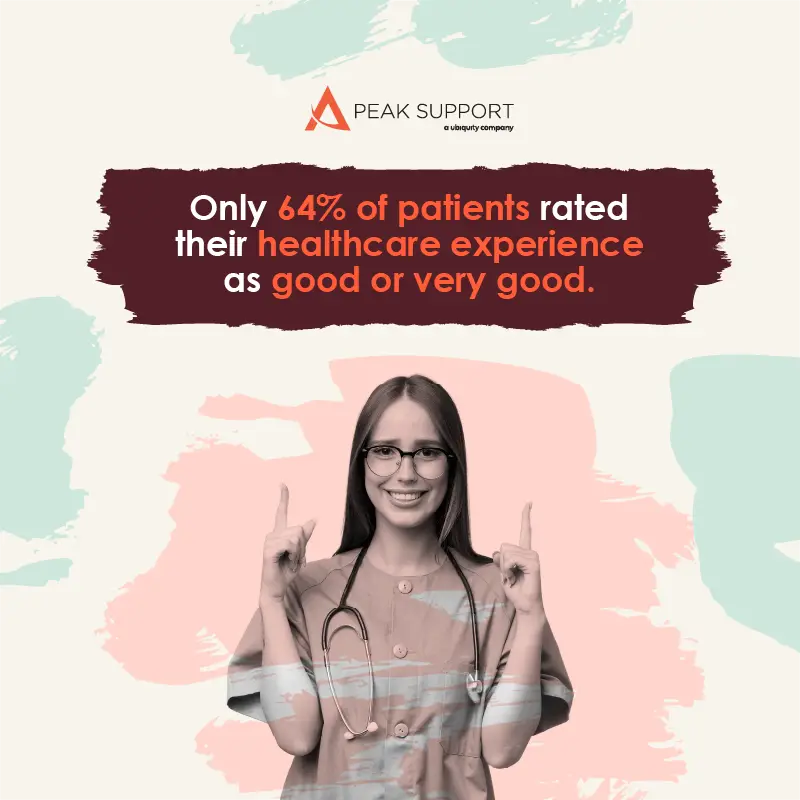
And patients are noticing. Recent patient experience research found that only 64% of patients rated their healthcare experiences as good or very good, highlighting a growing gap between patient expectations and the support many organizations are currently able to provide.
When patients struggle to get answers, schedule appointments, or resolve issues quickly, frustration builds fast. Over time, those experiences shape how patients view the quality of care itself.
Why “Making It Work” Is No Longer Working
Many organizations try to solve these challenges incrementally, adding more staff, bringing in virtual assistants, or adjusting workflows.
But these fixes don’t address the core problem.
Support isn’t centralized.
It isn’t designed for high-volume interactions.
And it isn’t built with the right mix of technology and expertise.
The strain doesn’t just impact operations—it impacts people. As of 2025, nearly half of doctors and nurses in the U.S. report experiencing chronic exhaustion. As administrative and patient support responsibilities continue to grow, internal teams become increasingly stretched thin.
Over time, this creates:
- Burnout across internal teams
- Inefficiencies that slow down operations
- A reactive, inconsistent support experience
What seems like flexibility becomes a long-term constraint.
The Shift to Healthcare Contact Center Services
This is where the shift is happening.
Healthcare organizations are increasingly turning to healthcare contact center services to create structured, scalable support systems that can handle both volume and complexity.
Unlike fragmented in-house models, contact center environments are designed for:
- High-volume patient interactions
- Consistent, high-quality service
- Integrated systems and workflows
- Measurable performance and continuous improvement
This shift isn’t just about handling more calls—it’s about delivering better experiences at scale.
Where Healthcare Contact Center Automation Fits In
Technology is playing a bigger role in how support is delivered.
Healthcare contact center automation helps streamline repetitive tasks like appointment scheduling, basic inquiries, and routing—reducing wait times and freeing human agents for more complex, high-value interactions.
But automation alone isn’t enough.
The real impact comes from combining automation with trained support teams who can deliver empathy, clarity, and accuracy when it matters most.
Why Healthcare Contact Center Outsourcing is Growing
For many organizations, building this level of capability internally isn’t realistic.
That’s why healthcare contact center outsourcing is becoming a more strategic decision—not just an operational one.
With the right partner, healthcare organizations can:
- Scale support without overloading internal teams
- Improve response times and consistency
- Access experienced agents trained in high-volume support environments
- Integrate technology and workflows more effectively
This is where healthcare BPO services provide real value—bringing together people, process, and technology in a way that most in-house teams can’t replicate alone.
For a deeper look at how this works, explore Healthcare Outsourcing: The Complete Guide to Healthcare BPO Services and Benefits
What the Future of Healthcare Support Looks Like
The future isn’t about replacing internal teams—it’s about supporting them with the right systems.
That includes:
- Dedicated support teams trained for patient interactions
- Omnichannel communication across phone, chat, email, and SMS
- Automation that improves speed without sacrificing quality
- Scalable operations that adapt to demand
Healthcare organizations that invest in these models aren’t just improving efficiency—they’re improving access, experience, and outcomes.
What This Shift Means
Healthcare support is no longer something that can be managed on the side.
As demand grows and expectations rise, organizations need systems that are built for scale, consistency, and quality.
More healthcare organizations are investing in healthcare contact center services and healthcare BPO support as existing support models become harder to scale efficiently and consistently.
How Peak Support Helps Healthcare Organizations Scale Patient Support
At Peak Support, we help healthcare organizations move beyond fragmented, in-house support models and build systems designed for scale.
Our teams combine experienced agents with modern technology and healthcare contact center services that improve efficiency, reduce burden on internal staff, and deliver consistent, high-quality patient experiences.
We integrate directly into your workflows, tools, and processes—so support feels like a natural extension of your organization, not a separate function.
Whether you’re exploring healthcare contact center outsourcing, expanding capacity, or improving performance, our approach to healthcare BPO support services is built to help you scale without sacrificing quality.