

How Outsourced Customer Support Can Deliver on What Your Brand Promises
- Peak Support

Article overview: Customers see what a company stands for when support has to make a judgment call. In outsourced customer support, those decisions depend on whether agents have room to think and whether company policies support the experience the brand promises. Strong CX outsourcing partnerships bring both together, helping teams spot policies that create friction and make sound decisions when the standard process doesn’t fit.
A Friendly Response Can Only Do So Much
A longtime customer realizes they missed the return window and contacts support hoping the company will understand. The agent responds warmly, but even this small exception has to be approved by someone else. What should have been a simple request now leaves the customer waiting, which feels surprisingly rigid from a company known for making returns easy.
That disconnect is what the customer will remember. A friendly response can’t make up for a return policy or approval process that contradicts the convenience the company promotes. The stakes are high, too. In Zendesk’s 2025 CX Trends Report, 63% of consumers said they would switch to a competitor after just one bad experience.
Outsourced customer support makes this disconnect easier to spot. An outsourcing partner can use the right tone and follow the approved scripts, but those guidelines only influence what agents say. When a request falls outside the standard return policy, approval rules determine whether the support team can make a reasonable exception or leave the customer waiting.
For the customer, that decision says more about the brand than a perfectly worded response ever could. A company known for easy returns must give its outsourced team a practical way to deliver on that reputation, especially when a customer’s situation doesn’t fit neatly within the policy.
When the Usual Answer Falls Short
Some customer issues fall outside the usual policy or leave agents choosing between two reasonable responses. Without clear guidance, the process may end up deciding how the customer is treated.
A brand pressure map helps companies examine these gray areas. Start with recent support conversations that required an exception, approval, or judgment call, then ask:
- What did the customer expect? Consider what the company promised through its policies, marketing, or reputation.
- Where did the process fall short? Find the point where the standard steps no longer fit the situation.
- What held the agent back? Look for missing information, unclear guidance, or approval requirements.
- Did the resolution reflect the brand? Compare the decision with the experience the company promises.
- Has this happened before? Recurring cases may point to a larger problem in how customer service is set up.
For example, an outsourced customer support team can’t provide clear updates about a delayed order if the fulfillment team shares incomplete information. The pressure map traces the customer’s frustration back to that information gap, giving the company and its CX outsourcing partner a specific problem to address.
When Brand Values Are Too Vague
Words like “helpful,” “transparent,” and “customer-first” may describe a brand, but they give an outsourced customer support team little direction when a decision requires judgment. Companies need to define what each value should look like for the customer and what agents need to deliver it.
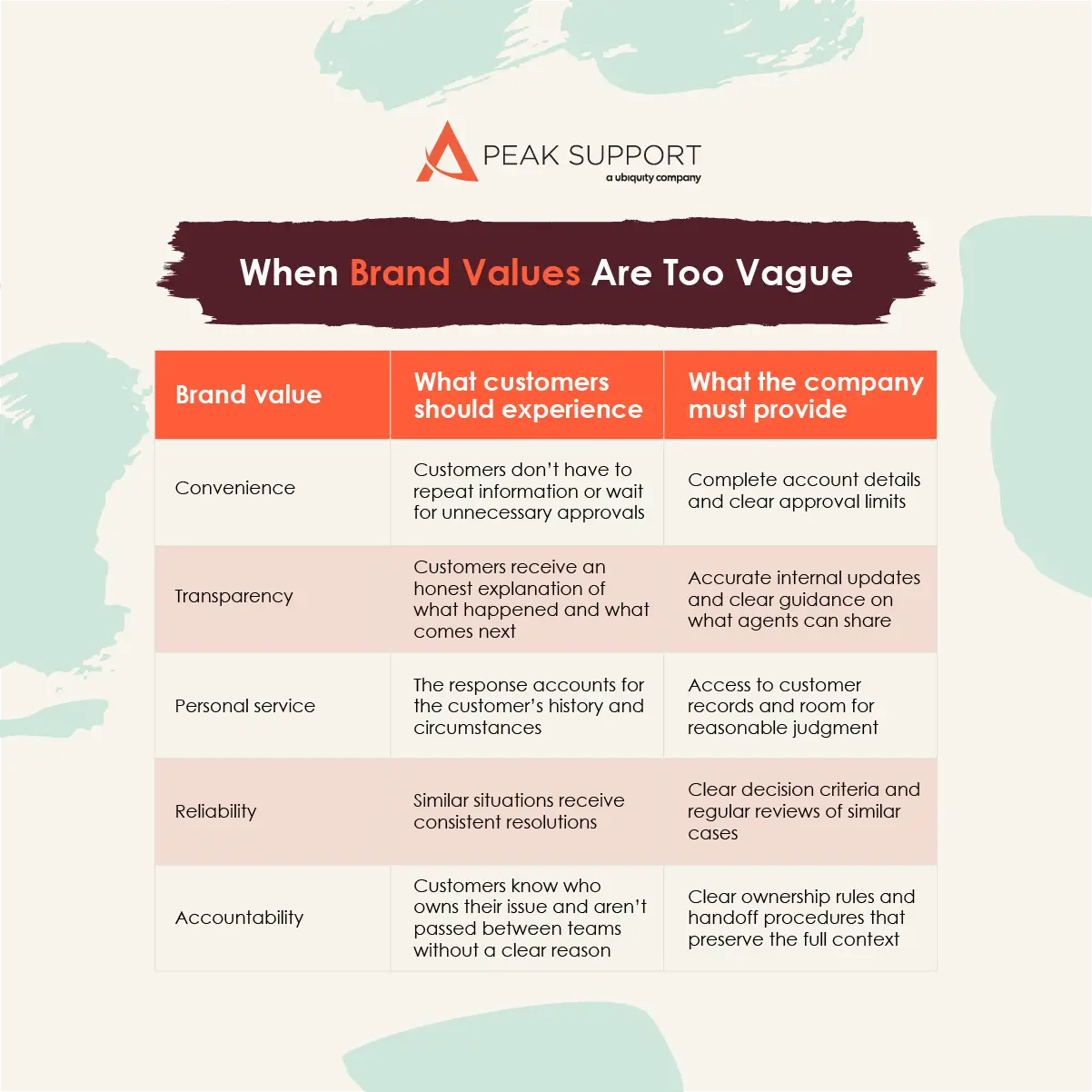
The table gives the company and its CX outsourcing partner a shared definition of each value. It also reveals practical gaps, such as approval rules that slow down simple requests or missing updates that leave agents with little useful information to share. This makes brand values easier to apply across everyday customer service decisions.
When Company Policies Work Against the Brand
A company can promise convenience while requiring several approvals for a small account credit. It can promote transparency while giving its outsourced customer support team limited information about fulfillment delays. Even attentive service becomes harder to deliver when agents are measured mainly on how quickly they end each conversation.
Better scripts and more coaching won’t solve those contradictions. Before training begins, the company and its CX outsourcing partner should compare what customers have been promised with the rules and systems agents will rely on. A policy contradiction audit should cover:
- Refund and replacement rules: Do the requirements match how easy and flexible the company claims to be?
- Approval thresholds: Which decisions can agents make on their own, and which ones create unnecessary waits?
- Escalation requirements: Does an escalation lead to meaningful help or simply move the customer to another queue?
- Service-level targets: Do response and resolution goals leave enough room to handle more involved cases properly?
- Agent performance measures: Are agents rewarded for resolving the issue or mainly for ending the conversation quickly?
- Information access: Can the support team see the account, order, product, and fulfillment details needed to give a useful answer?
The audit may reveal that the outsourced team is being asked to deliver an experience the company’s own rules make difficult. Catching those conflicts before onboarding gives the company and its CX outsourcing partner time to adjust the process and establish what agents can realistically decide.
When the Right Call Isn’t Obvious
Some customer issues leave room for more than one reasonable response. An account may be flagged after an unusual login, even though the customer has a credible explanation for the activity. A promotion may have technically expired, but unclear wording on the website gave the customer good reason to believe it was still available. Policies can establish the boundaries, but they can’t decide every case for the support team.
A decision library gives the company and its CX outsourcing partner a practical way to show how those judgment calls should be handled. Build it from anonymized customer cases where the right response wasn’t immediately clear. Each case should cover:
- What did the customer need? Explain the request and any relevant account history.
- Which policies applied? Include the rules agents had to consider.
- What made the decision difficult? Point out the conflicting factors, missing details, or unusual circumstances.
- Which options were considered? Show the possible resolutions and what each one would mean for the customer and the company.
- Why did the company choose that response? Explain how the final decision reflected its standards for customer service.
A simple decision log can capture new judgment calls as they happen. During regular reviews, the company and its CX outsourcing partner can look for cases that keep appearing, reveal missing guidance, or set a useful precedent. Those cases can then be added to the decision library for future onboarding, coaching, and QA reviews.
The most useful examples won’t always have an obvious answer. Borderline cases show how the company weighs its policies against fairness, cost, customer history, and risk. As the library grows, that knowledge becomes available to the entire support team instead of remaining with a small group of experienced employees.
When Every Decision Needs Approval
Giving agents authority doesn’t mean approving every request without review. It means setting clear limits so the outsourced customer support team knows which decisions agents can make and when a team lead or the company needs to step in.
A decision-rights matrix can make those limits easier to follow:
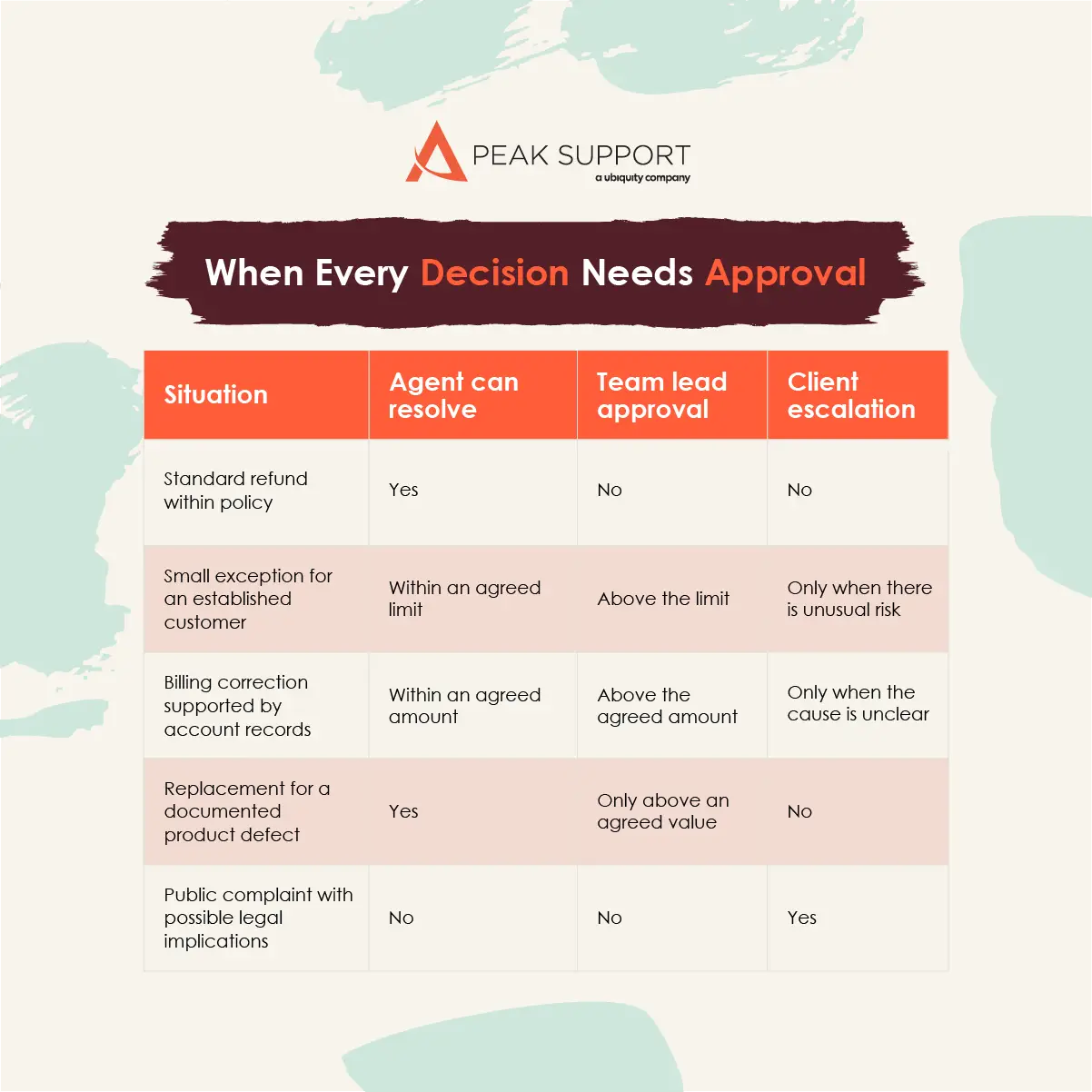
The exact limits will depend on the company, but the purpose stays the same. Agents shouldn’t have to chase an approval for decisions they’re already trusted to make. They should also know exactly when a request carries enough financial, legal, or reputational risk to involve the client.
When QA Only Checks the Reply
An on-brand response can still leave the customer with a poor resolution. QA reviews should consider whether the agent understood the customer’s actual need, had enough information and authority to respond fairly, and reached a decision that reflected the company’s brand values. Reviewers should also note when unclear guidance could lead another agent to handle the same case differently.
Looking across several reviews can show whether the same problems are appearing throughout the outsourced customer support operation. Pay attention to patterns such as:
- Cases delayed by approval: Agents may have less authority than they need.
- Similar issues with different resolutions: Policies or decision guidelines may be unclear.
- Repeat contacts after a case is closed: The original resolution may not have addressed the full issue.
- Escalations caused by missing information: Internal updates may not be reaching the support team.
- Decisions overturned during QA: Agents may need clearer examples or easier access to guidance.
These patterns help the company and its CX outsourcing partner see where the operation may be limiting good judgment. They can then adjust the guidance, access, or authority agents need to make better decisions.
Give Your Outsourced Team More Than a Script
The clearest test of brand alignment comes when the policy leaves room for judgment. At that point, an outsourced customer support team needs to understand how the company balances customer needs with business risk. Otherwise, the brand promise can disappear as soon as the script stops being useful.
Peak Support helps clients define what good judgment looks like before agents have to use it. We turn brand expectations into practical guidance and clear decision boundaries based on the situations customers actually bring to support. This gives agents the confidence to handle gray areas while giving clients greater trust in the decisions made on their behalf.
Partner with Peak Support to build an outsourced support operation your company and your customers can rely on.