

Retail Customer Experience Outsourcing: From Order Placed to Order Again
- Peak Support

Article overview: A retailer can lose the next order while sorting out the current one. Outsourced agents handling customer order problems need enough context to solve them without adding to the frustration. Retail customer experience outsourcing now puts more responsibility on the partner to keep post-purchase support running smoothly as the way customers shop and ask for help continues to change.
One Simple Question, Plenty of Order Details Behind It
“Where is my order?” sounds easy enough. Then the agent opens the shipment tracking page and finds the same outdated delivery status the customer already saw. The package should’ve arrived yesterday, so another tracking link won’t cut it.
The outsourced agent now has some digging to do. They need access to the right order details, a clear next step, and enough authority to offer real help. Without that support, a basic delivery question can quickly push the customer to shop elsewhere. Some customers follow through on that. In PwC’s 2025 Customer Experience Survey, 29% of consumers said they had stopped buying from a brand because of poor experience online or in person.
Customers also don’t always use the same contact method when they need help. They might send a direct message before following up through email. When those interactions aren’t connected, customers have to repeat themselves and agents risk giving conflicting answers.
That’s the job retail customer experience outsourcing has to take on today. An outsourcing partner needs to give agents the context and support to handle customer order problems properly, even when order volume spikes. How it handles the current order has a direct say in whether the customer places the next order.
Customers Won’t Wait in One Place
Customers sometimes switch contact methods to see which one gets noticed first. If an email remains unanswered, they might send a direct message or open a chat about the same order. When each message becomes a separate ticket, two agents can end up investigating one problem while the customer receives different answers.
Retail customer experience outsourcing has to account for that behavior instead of treating each message as a new problem. Good omnichannel customer support keeps the issue intact wherever the customer follows up. Retailers and their outsourcing partner can make that easier by:
- Putting the full interaction history in one place. Agents should be able to see what the customer has already explained without searching through separate platforms.
- Catching duplicate requests early. Messages about the same order should be linked or merged before different agents start working on them.
- Keeping one agent responsible when possible. Clear ownership lowers the chance of repeated questions and keeps the customer from being passed around unnecessarily.
- Giving every agent the same order information. Shipping updates, return progress, and previous resolutions should match across contact methods so customers get the same answer regardless of how they contact support.
- Tracking when customers switch contact methods. Frequent switching may reveal slow replies or help content that isn’t answering the customer’s question.
Effective omnichannel customer support lets customers change contact methods without hitting reset on the whole order problem.
Peak Season Shows Up Early for Support
Retailers already know when order volume is about to climb. The support problems that follow are less predictable. One promotion may bring more questions before checkout, while another creates problems after orders ship. Last year’s ticket total won’t tell an outsourcing partner what agents need to be ready for this time.
Retailers and their outsourcing partner can prepare by:
- Sharing the sales calendar early. Upcoming promotions and expected order volume give the partner time to plan coverage before customer requests pick up.
- Reviewing what drove past demand. Previous support records can show which products, policies, or promotions created the most customer questions.
- Training agents on likely scenarios. Readiness checks can confirm that added agents know how to find the right information and respond when the usual answer doesn’t fit.
- Updating support materials before the rush. Agents shouldn’t find out about a new promotion or return rule from the customers contacting them.
- Watching more than response time. During a surge, retail customer service outsourcing should also be measured by answer accuracy, repeat contacts, and escalations. Speed doesn’t count for much when the customer has to ask twice.
The holiday rush is no time for an outsourcing partner to still be reading the brief. Getting access to the retailer’s plans early gives agents time to prepare before customer requests start stacking up.
The Bot Needs a Clear Job Description
Adding AI to retail support shouldn’t begin with deciding how many customer inquiries it can handle. A better starting point is deciding which inquiries it can answer correctly with the information and authority it has.
An AI support bot works best when the answer comes from a reliable source and follows a clear rule. Human agents should take over when the information conflicts, the standard policy doesn’t fit, or the customer needs a decision the bot can’t make.
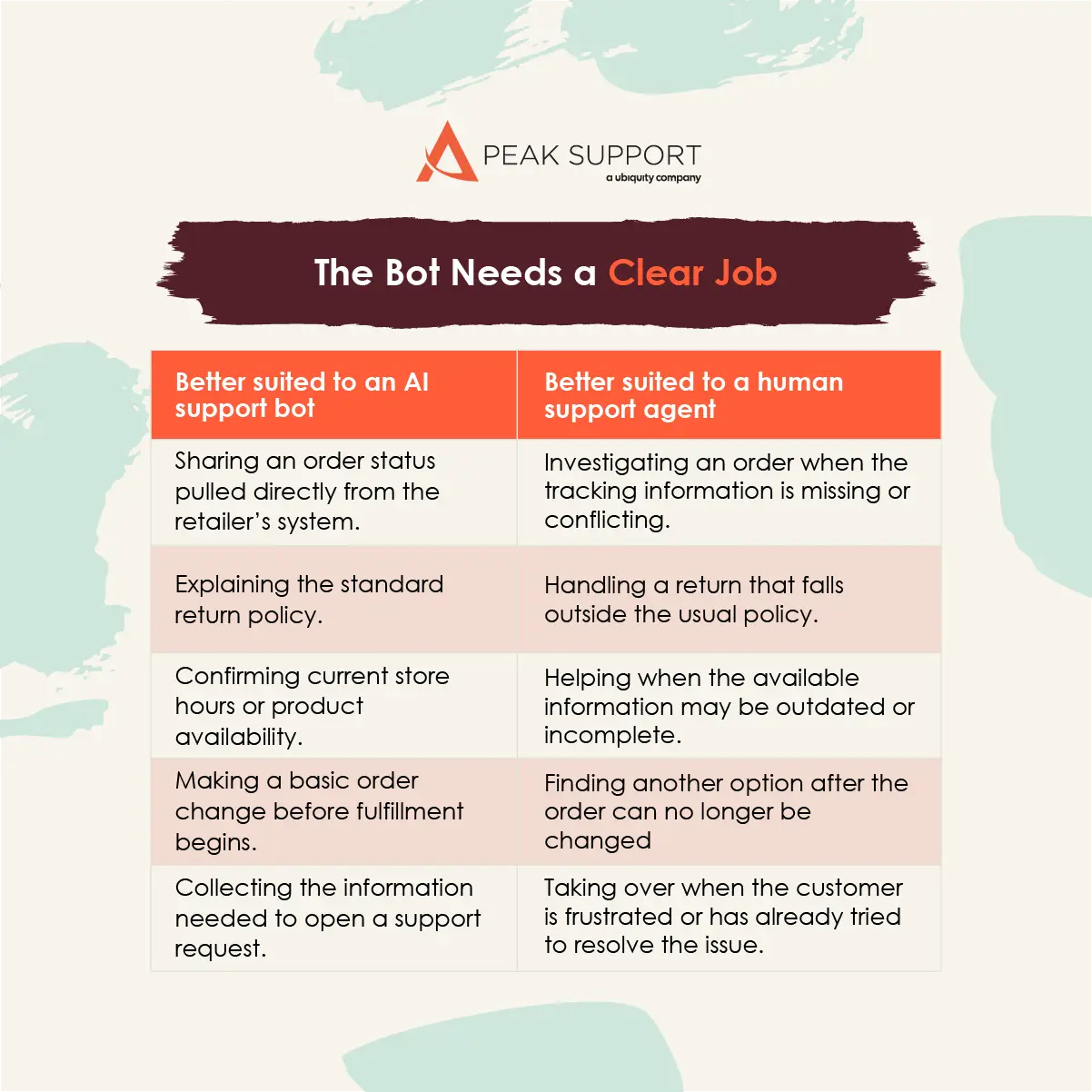
An AI support bot should know when to leave the chat. Once it hits its limit, it needs to send the issue to a human agent with a useful recap of what it tried and where it got stuck. The agent can go straight to the decision the bot couldn’t make.
With retail customer experience outsourcing, the outsourcing partner can’t launch the bot and call it done. If customers keep asking for a human agent at the same point, the bot needs a better answer or an earlier exit. AI does its job best when it knows where to stop.
The Same Problem Should Follow the Same Rules
Two customers can contact support about the same delivery problem and walk away with completely different answers. One agent may offer a replacement while another tells the customer to wait three more days. Even if both responses sound perfectly on-brand, the difference in resolution is what customers will remember.
Consistent support starts with making the retailer’s decisions clear. Agents need to know how common order problems should be handled and when an exception makes sense. If one agent approves an exception, the reason should be recorded so the next agent can understand what happened instead of reversing the decision.
A return policy change can still cause confusion after agents hear about it. The old version may remain in a saved reply or internal guide and end up in the next customer response. A simple update process should cover every support resource and assign one person to make the changes. Agents can then follow the current policy without stopping to compare versions.
QA reviews for retail customer service outsourcing should look for differences in how similar cases are resolved. Retailers and their outsourcing partner can review a small group of real cases together and agree on the right response. That gives agents clearer direction while leaving room to handle the details of each customer’s situation.
The Same Questions Keep Coming Back for a Reason
A jump in “Where is my order?” requests can mean the order updates aren’t doing their job. When the tracking page hasn’t changed in days, asking support becomes the customer’s next move. Agents can clear those requests all day, but the inbox will keep refilling until the retailer gives customers better information.
Outsourced agents work close enough to daily customer issues to notice when one complaint turns into a pattern. Several delivery requests may lead back to the same unclear tracking message instead of separate order problems. By tagging contact reasons consistently and noting what customers couldn’t find, the outsourcing partner can show the retailer where the confusion begins and how widespread it has become.
A report that stops at “return questions increased” gives the retailer a fact but no idea what to do next. To make that finding useful, the report should answer:
- What changed? Show how much the issue increased and when the change began.
- Where did it start? Identify the product, policy, promotion, or step in the order process connected to the requests.
- What are customers saying? Include a few examples that explain the frustration in their own words.
- What could reduce the volume? Recommend a specific update, then track whether it leads to fewer contacts.
When the outsourced support team spots a recurring problem, the outsourcing partner should bring real customer examples to the retailer. Say shoppers keep misunderstanding a product page. Their messages give the ecommerce team something concrete to fix. Once the page is updated, the outsourcing partner can watch incoming requests to see whether customers finally stop asking the same question.
This is where retail customer experience outsourcing shows its value outside the support inbox. When a partner helps fix a recurring source of frustration, fewer customers run into the same problem, making it easier for them to order again.
Each Order Has to Earn the Next One
Retailers don’t get another sale simply because the first order made it through checkout. Customer support still has plenty of say in whether someone comes back. The outsourcing partner should know which solutions are available when an order goes sideways and let agents use them without unnecessary delays. That puts retail customer experience outsourcing right at the point where a customer decides whether the brand gets another order.
Peak Support has helped dozens of ecommerce brands scale customer service. One client maintained a 97% CSAT while growing its support team with us, while another reduced churn by 50% over two years and kept CSAT above 96%.
We have the track record to back up our approach to retail customer service outsourcing. Talk to the Peak Support team about what better support can do for the next order.