


Article overview: Customers won’t care how many contact options a company offers if changing from chat to phone means telling the whole story again. This article gets into what separates multichannel support from an omnichannel customer experience and how technology, staffing, and case ownership need to work together. Real client results put those decisions into context, helping companies decide what to keep in-house and what makes more sense to outsource.
Offering Different Support Channels Isn’t Enough
If a customer chats with support about a missing order and calls back later, the phone agent should be able to continue where the chat left off. Otherwise, the customer has to repeat the whole story while the agent collects information the company already has. That repetition can also lead to a different answer or another round of steps that didn’t work the first time.
Offering several ways to contact support makes the operation multichannel. It becomes omnichannel when the relevant customer history is available across email, phone, chat, social media messaging, and the company’s other support channels. This allows the same case to continue when the customer changes how they contact support. A shared customer profile only helps if the agent taking over can see what was promised and what needs to happen next.
Customers feel the difference when the next agent already knows the story. Instead of another recap, the conversation starts with what needs to happen next. That’s an omnichannel customer experience doing its job.
Multichannel and Omnichannel Support Solve Different Problems
Multichannel and omnichannel support can offer the same contact options. The difference is how the support operation handles a case after the customer moves from one option to another.
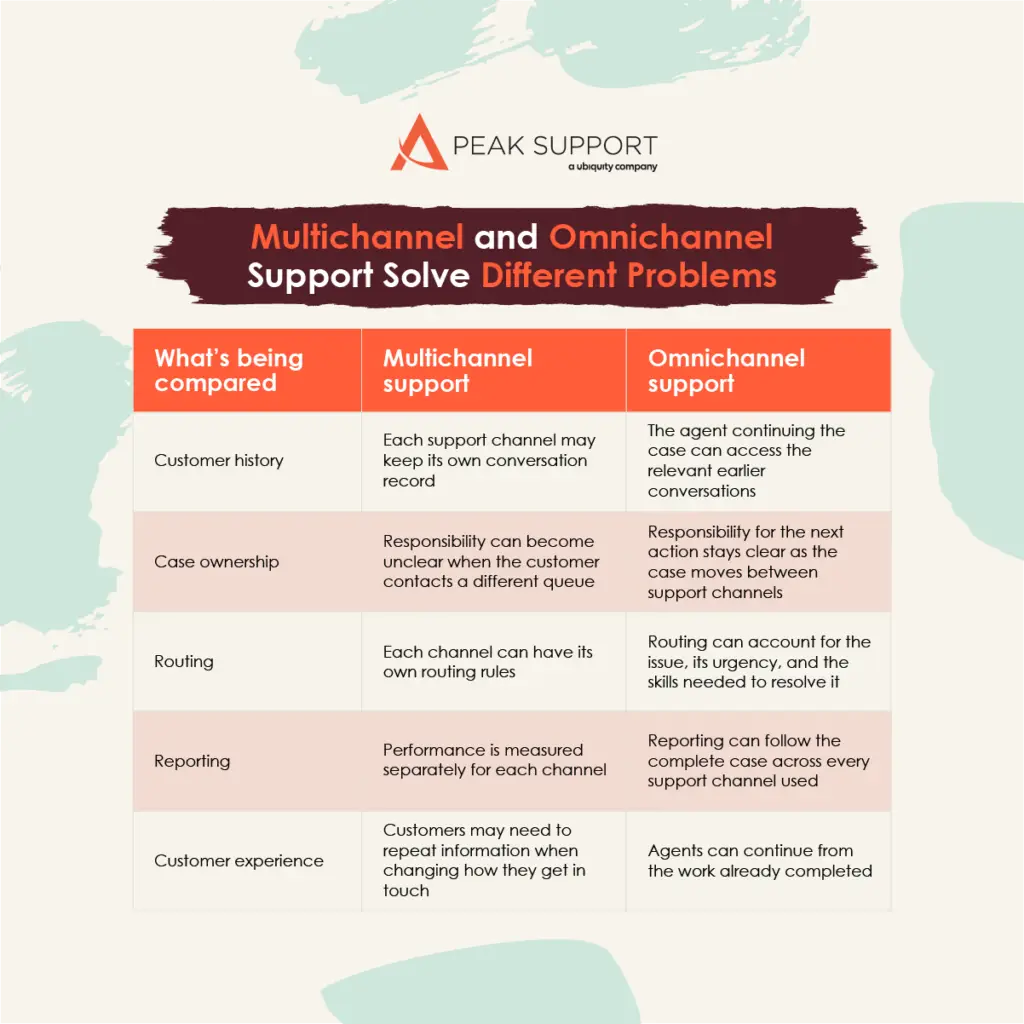
Multichannel support isn’t automatically a poor experience. It can work well when customers complete an issue through one support channel. Its limits become clearer when a public social media message needs to continue privately or an email case requires a phone call for identity verification.
An omnichannel CX strategy should explain exactly how that change will be handled. The support agent taking over needs access to the earlier conversation and clear responsibility for the next action. Companies can test whether the omnichannel customer experience works as intended by tracing real cases that used more than one support channel and checking whether customers had to repeat information or restart any part of the resolution.
The Next Support Agent Should Already Know
Zendesk reports that 62% of customers expect personalized and consistent interactions regardless of the channel they use. Put plainly, changing how they contact support shouldn’t change the answer. A refund approved over chat shouldn’t become a brand-new request when the customer calls.
Preventing that takes more than shared customer history. Every support team also needs to work from the same current policies. If phone agents have the latest eligibility rules for a promotion while the social media team relies on an older document, customers can receive conflicting answers even when their conversations are connected. Assigning each policy an owner helps ensure that new guidance replaces outdated versions in every support workspace.
Sharing current guidance is only half the job because access to customer data still needs boundaries. An agent needs enough information to continue the case without receiving unrestricted access to payment details or other sensitive account information. When a customer posts publicly on social media, any account-specific discussion should move to an approved private support channel. The next agent can then give a consistent answer without receiving access to information they don’t need.
Omnichannel Support Needs More Than Another Inbox
Customers can send support questions through Instagram before the company formally offers help there. If the company decides to handle those questions on Instagram, support agents need access to customer records and the authority to resolve common requests instead of sending every customer to email. Before promoting the channel, the company should make five operational decisions as part of its omnichannel CX strategy:
- Measure the current demand. Review the support questions received during a specific month or quarter and group them by contact reason. If most concern order updates, support agents will need access to the company’s order management platform.
- Set the channel’s scope. Decide which requests support agents can complete through Instagram and how quickly they should respond. The operating hours and response target need to match the available coverage.
- Name each platform and data source. Choose whether the help desk or CRM will hold the main case record, then document where support agents will retrieve the necessary account information. Set rules for matching an Instagram profile or phone number with the correct customer record. An uncertain match should trigger customer verification.
- Build the staffing forecast. Use expected contact volume and average handling time to calculate the required coverage. For channels such as live chat, also test how many simultaneous conversations a support agent can manage without response times or accuracy declining.
- Open with limited coverage. Start with set operating hours and a small group of trained support agents. Compare the actual volume and handling time with the forecast, then adjust coverage before promoting the channel more widely.
Once support agents can resolve the expected requests within the promised response time, the channel is ready to support a broader omnichannel customer experience.
The Technology Has to Fit the Support Work
Connected platforms should make an omnichannel customer experience easier to deliver by reducing the steps support agents have to take. Seeing an order status inside the help desk saves time, but the benefit is limited if correcting a shipping address still requires another application and a manual update to the support case.
An omnichannel CX strategy should identify where support agents retrieve order status or subscription details and whether they can update that information from the help desk. When an update is allowed, it should sync with the original platform and be recorded in the support case.
Even with those rules in place, integrations can fail. If order data stops updating, support agents should see a warning and follow a documented backup process instead of treating outdated information as current. In outsourced omnichannel support, the BPO and client should agree on who monitors each integration and how failures are reported.
BPOs Shouldn’t Need a Green Light for Everything
In an outsourced omnichannel support partnership, the BPO should be able to adjust a schedule without waiting on an email chain. Changes to customer policies or access to the client’s billing platform still require client approval. Setting those boundaries early lets the BPO’s operations team handle daily needs without stopping to ask permission every time.
A product release can push live chat volume above the original forecast. When the increase fits within the approved staffing range, the BPO can reassign available coverage and track whether demand stays high. Continued demand can then be brought to the client with the contact numbers and a staffing recommendation. When the conversations reveal a product issue, the BPO can send customer examples to the client’s product team so it can address the problem.
Weekly reviews can cover current workload and cases awaiting a client decision, while monthly meetings revisit changes made earlier. If a new process was meant to reduce repeat contacts, the BPO and client can compare the current rate with the baseline and decide whether to keep the change or revise it.
Two Clients, Two Different Support Needs
When Peak Support began working with The Community Company in 2017, the client wanted clearer customer service standards and better performance data. Peak Support reviewed the existing operation, defined KPIs the team would track, and later recommended moving to Zendesk. Peak Support also took responsibility for live chat and email support, including coverage outside regular business hours. From 2018 to 2019, monthly ticket volume grew from about 2,000 to 4,000, while the Peak Support team only added one support agent. The Community Company recorded a 97% CSAT score in 2019. Seven years later, the partnership is still delivering: the team posted 100% CSAT for the week of August 10, 2026.
Wildgrain needed a different kind of support. After handling member questions herself for nine months, VP of Marketing Ali Mooradian trained the first Peak Support team member, who then trained the support agents who followed. Peak Support went on to manage Wildgrain’s email and social media comment support, while the outsourced team grew from three people to 34. The team handled more than 60,000 support tickets with an average CSAT score of 97.6%.
The two partnerships didn’t follow the same plan. The Community Company needed stronger reporting, updated technology, and dependable coverage across live chat and email. Wildgrain needed to scale support across email and social media while training new support agents to match its brand voice. Their results show why outsourced omnichannel support has to be built around the client’s operation rather than treated as a standard package of channels.
One Standard Across Every Support Channel
Every new support channel gives customers another convenient way to reach the company. With omnichannel support, emailing, calling, or sending a social media message should still feel like contacting the same company. Customers receive consistent information from a support team that understands the brand.
When a client updates a policy, the Peak Support account leader turns that decision into clear guidance for the support team across every channel in scope. The change is reinforced through coaching and checked in quality reviews, giving the client a clear view of how consistently the policy is being applied. This gives the client one accountable team for managing the omnichannel customer experience as the business grows.